
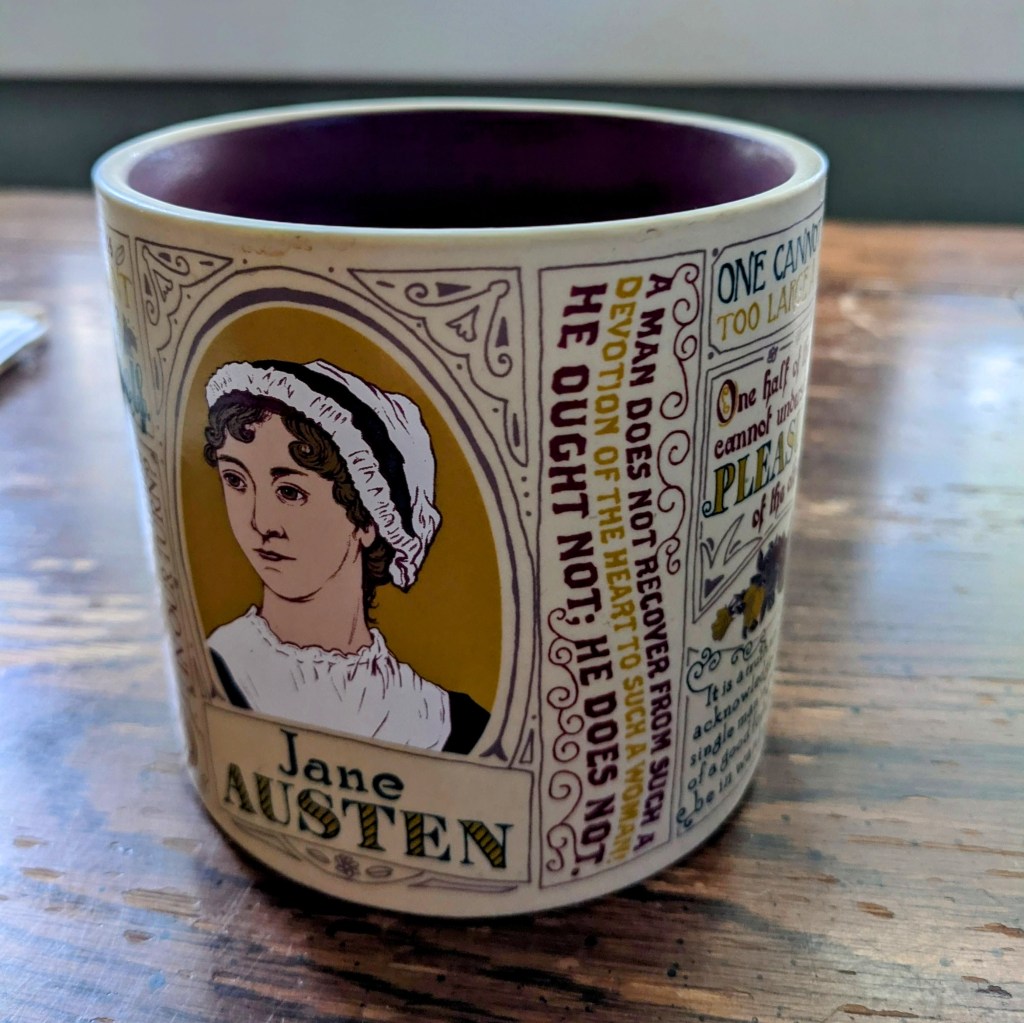
I have a favorite coffee mug I use nearly every morning. It’s the perfect size for my favorite beverages, which is, of course, an essential quality for any mug. But I also love it for another reason: it’s a literary mug covered in quotes from Jane Austen’s classics. I get to sip my coffee out of something that reminds me of Pride and Prejudice, Sense and Sensibility, Persuasion, and her other works that I have enjoyed reading and rereading over the years.
The other day, my young daughter was reading these quotes, and a simple fact hit me: because she hasn’t read any of the books, she has no idea what any of these lines mean. Taken out of context, they are random (“One cannot have too large a party” – alright), confusing (“Let other pens dwell on guilt and misery” – huh?), and sometimes even misleading (“The more I see of the world, the more I am dissatisfied with it; and every day confirms my belief of the inconsistency of all human characters” – not the full message about humanity that I want my daughter to internalize).
My daughter was understandably bewildered by what was written. Disconnected from the original context, these lines lost their meaning. The full force of what was being said was gone because she didn’t know who said it, who was meant to hear it, and what the rest of the storyline fills out.
The same is true when it comes to memorizing Bible verses. One of the greatest blessings we have here on earth is that God has given us His Word, and memorizing it is a good and valuable practice. “How sweet are Your words to my taste,” the author of Psalm 119 praises, “sweeter than honey to my mouth!”1 To treasure what He has said and to spend time memorizing pieces of it is an incredible gift and joy. But if we neglect the context, we can end up memorizing a beautiful verse but unintentionally understanding something different from what the author intended. I have done this far too often.
“I can do all things through Christ who strengthens me,” from Philippians 4:13, becomes a verse about winning a game.
“God is in the midst of her; she shall not be moved,” from Psalm 46:5, becomes a verse celebrating girl power.
“‘For I know the plans I have for you,’ declares the Lord, ‘plans to prosper you and not to harm you, plans to give you hope and a future,’” from Jeremiah 29:11, becomes a verse that convinces us that only good things are coming our way in the here and now.
These are beautifully true and good verses, and they are common – and good – memory verses for a reason. What we want, though, is right memorization, not rote memorization, rooted in the surrounding verses, chapters, book, or storyline of the entire Bible.
Misapplication can lead us to false hope, which easily leads to disappointment. When something happens that seems contrary to the verse we’ve memorized, we may even be tempted to question God and His character. We think, “You promised,” when really, we’ve just misunderstood the promise He made.
Misapplication also risks putting ourselves at the center of Scripture. While it’s true that God loves us far beyond what we can imagine, it’s also true that we are not the center of any story being written. We are creatures made in the image of God, and our lives are meant to point together to Him, not as individuals shining a spotlight on ourselves. When we minimize what God has done, is doing, and will do throughout history, we end up seeing ourselves more than we see Christ, the true center of Scripture.
Still, not every verse memorized out of context will lead us into grave danger of misapplication. However, even if we understand the verse correctly, knowing the surrounding Scripture as well as considering the original author and audience deepens our understanding of the verse on its own.
God can even use our misunderstandings to guide us into true knowledge and deeper faith. Over time, with prayer and pursuit of God, He sheds the layers of our own thinking and shapes it to become more like His. But that’s not an excuse to leave our current understanding of the verse where it’s at. Imagine being satisfied with willfully misunderstanding a friend, a child, or a spouse! So with our Heavenly Father, let’s dig deeper and continue to ask Him to shape us rightly through His truth.
Someday in the not-too-distant future, my daughter will read Jane Austen’s classics, and we will discuss them together while sipping our coffees out of matching Jane Austen mugs (a mom can dream, right?). But more than I long for that day to come, I long for the day when I can sit with all of my kids and talk about the fullness of the Word of our God. I hope they (and I!) have many Bible verses memorized to remind us of God’s truth, character, and plan in good times and bad. And I pray God uses the entirety of His Word to teach us and guide us into deeper knowledge and love of Him.
—
Looking for help getting started memorizing Scripture? There are many resources out there, but here are a few additional articles that may be useful.
John Piper How Do You Memorize Scripture? | Desiring God
George Sinclair The Great Good of Bible Memorization – The Gospel Coalition | Canada
Andrew David Naselli 11 Steps to Memorizing an Entire Book of the Bible
- Psalm 119:103 ↩︎
Discover more from Soaking in the Son
Subscribe to get the latest posts sent to your email.
 Soaking in the Son